Monday, June 8, 2015

Sunderland on Grass

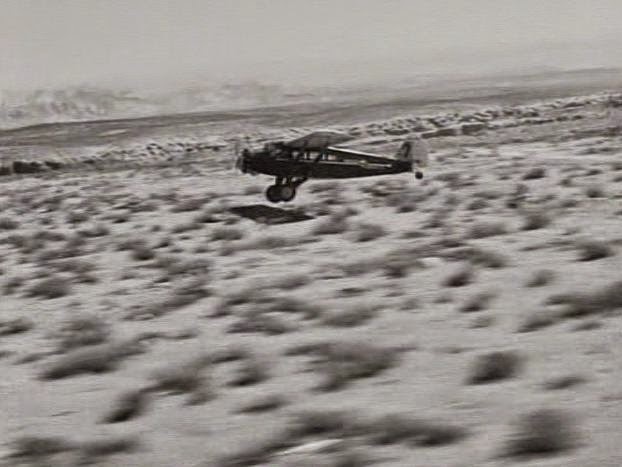
W.W.II is full of remarkable and unique events. As a counterpart of the earlier post about a large flying boat taking off from an airfield (here) this is a film of a large flying boat landing on a grass airfield.

The Short Sunderland of 461 Squadron RAAF had managed to take off in a heavy sea, after a remarkable multiple open-sea rescue effort, but smashed a huge hole* in the forward planing hull, meaning there was no way it could land back on the water.

Despite being a pure flying boat, not an amphibian, the crew decided to land on the local airfield of Angle Aerodrome, near their base. This film footage was shot by the squadron commanding officer from a car chasing the landing Sunderland.

Having read about the story recounted with remarkable presence and emotion by Ian Southall (a decorated 461 Sunderland commander himself, and later writer of the official squadron history) in 'Fly West', it was a great privilege a number of years ago to be able to view the footage on a VHS tape in the research library's video booth at the Australian War Memorial (AWM).  The film brough something I'd read about to life in a dramatic and different way.

The smiles of the relieved crew were an unforgettable memory.


Now, the film is uploaded by the AWM on their website (here) and, as we see above, is also shared on YouTube for any interested viewer, such is the accelerating pace of internet access.

Here is the film's description, including the crew details and the story of how they got to be in such an awkward situation:
"This is an eyewitness film which shows Sunderland 'E' of 461 Squadron RAAF landing on Angle aerodrome near Pembroke Dock, Wales on 29 May 1943. It was shot from a moving car by Wing Commander D L G Douglas, DFC, squadron Commanding Officer.
Aircraft 'E' for Emu sustained a large hole in the hull plates in the region of the toilet when taking off in a lumpy sea 150 nautical miles beyond Bishop Rock, after rescuing crews of two other Coastal Command aircraft. One of these was a Whitley and the other was Sunderland 'O' of 461 Squadron RAAF which had crashed while attempting to land to rescue the Whitley crew. Sunderland 'E' landed in the open sea at 7.00 hours (Double British Summer Time) at a spot 175 nautical miles southwest of Bishop Rock and picked up the two crews from dinghies.
As the sea was too rough for a take off the Sunderland began taxying towards England and at about 10.00 hours was met by the Free French destroyer La Combattanter. The destroyer took 21 persons including five of the Sunderland 'E' crew on board and sent an armourer to disarm the aircraft's depth charges which were then jettisoned. At 13.00 hours the destroyer took the Sunderland in tow but many difficulties were met. Finally at 15.00 hours the towline broke and at 18.00 hours preparations were completed for take off. This had to be commenced across wind because of the state of the sea and took three or four times as long as usual. It was finally achieved after turning head-on to the wind and striking large waves, the last one of which hurled the Sunderland into the air but also ripped a large hole in the hull. This ruled out any possibility of a sea landing.
At 20.00 hours Sunderland 'E' was near the entrance to Milford Haven and its skeleton crew spent the next half hour throwing overboard flares and loose heavy items in preparation for a crash landing. These preparations proved unnecessary when a gentle landing was made at 20.40 hours on the grassy Angle airfield. Half of 461 Squadron was at Angle airfield to see the landing and the unorthodox disembarkation of the crew. The motley uniforms worn by the crew were what was left after wet survivors of the two rescued crews had been given an open go at the clothing originally worn and carried by the crew of 'E'. The destroyers delivered all of its passengers safely including a pilot of Sunderland 'O' of 461 Squadron RAAF who had been very badly injured. Apart from him all the others were able to continue with their duties as soon as aircraft could be found for them. Sunderland 'E' for Emu never flew or floated again."
(Commentary written by Harry Winstanley, DFC)
 Crew members: Captain 400841 Pilot Officer (PO) Gordon O. Singleton of St Kilda, Vic; Co-Pilot 415195 Flight Sergeant (Flt/Sgt) Pearce E. Taplin of Midland Junction, WA; Navigator 401356 PO Harry Winstanley DFC of Geelong, Vic; Engineer 9429 Sergeant (Sgt) H. Hall of Moonee Ponds, Vic; Wireless operator-mechanic Flt/Sgt Hughie Church, RAF; Wireless operator-gunner 405228 Sgt Johnny Lewis of Brisbane, Qld; Airgunner 407210 Flight Officer George Viner of Adelaide, SA. 
* The hole in the Sunderland's hull (seen at 3:30 in the film) seems to have been about 2 metres by 1 metre (6 ft by 3 ft) and in the forward starboard area, where, if they had attempted to land, as the aircraft settled deeper, the water would have been forced into the hull by the aircraft's forward motion. Not only would it almost certainly have filled quickly and sank, there was a very real chance the sudden inrush of incompressible water would have blown the hull apart.

Wednesday, June 3, 2015

Westland History

It is always a pleasure to help out someone with their aviation book. A recent arrival was David Gibbings' 'A Quiet Country Town' published by The History Press.

It is, of course a history of Westland Aircraft, or as the subtitle says 'A celebration of 100 years of Westland at Yeovil'.


It's a very personal history, with a selection of chapters by numerous authors on aspects of the company's history, aircraft and people. David has added his own delightful pencil sketches as heading to each chapter, a great enhancement. Authors include authorities such as historian Derek James, Harald Penrose - the great Westland test pilot, Jim Schofield and Graham Mottram, as well as a modest contribution on the Wapiti by myself.

So although I'm slightly partisan, it's still highly recommended. Well worth bothering your local good bookshop or direct from the publisher as an e-book of hardback here.

CGI Pacific B-24s in 'Unbroken'

The recent film 'Unbroken' on the life of Louis Zamperini featured a significant section on his experiences as a Consolidated B-24 Liberator crewman in the Pacific, with several major incidents including a crash landing and being downed in the Pacific.

While there are currently two airworthy B-24s, understandably the film company chose to use majority of CGI (Computer Generated Imagery) for recreating the aircraft scenes, around a gimbal mounted B-24 replica fuselage to film the actors in the studio.

Much of the 'aerial' work was advised by my colleague Bob Livingstone, well-recognised B-24 authority, and he wrote up his experiences in a recent issue of Flightpath (Vol.26 No.3).


Here, the company Rodeo FX have put together a very interesting  showreel on the use of the CGI in the film, and I think it shows well the strengths of this often over-used and abused technology special effect, and, not incidentally, some of the weaknesses, not least unrealistic physics and motion. (Think about how an aircraft would pivot around a broken wheel, not against it, for one. And secondly, how a Zero's beam attack path really would work at the 200+mph speeds of a B-24.)  But these are, perhaps, nit pics. On the computer screen alone, many of these scenes are impressive and as presented here, fascinating to see how they're put together.

View on.

Tuesday, April 21, 2015

'The Wind' - the Luftwaffe's bombing of Rotterdam

In May 1940 the German Luftwaffe deliberately chose to bomb the city of Rotterdam on 14 May 1940 with the sole objective of breaking the Dutch will to fight. After effectively razing the mediaeval city centre, the threat of bombing Utrecht was enough to cause the Dutch Government to surrender.

"The German ultimatum ordering the Dutch commander of Rotterdam to cease fire was delivered to him at 10:30h on 14 May 1940. At 13:22h, German bombers set the whole inner city of Rotterdam ablaze, killing 814 of its inhabitants." The photo was taken after the removal of all debris. [Source, Via Wikipedia Commons: http://www.archives.gov/research_room/arc/ ARC Identifier: 535916; U.S. Defense Visual Information Center photo HD-SN-99-02993]

While this was not the first bombing of a city by a long way, it was in many ways the precedent that unleashed the dreadful bomber war where millions of civilians (engaged in war work or not) as well as the military were killed, disabled or made homeless in the pursuit of destroying a nations will to fight.

This was the 'wind' that 'Bomber' Harris referred to when he stated that, quoting the Bible:

"The Nazis entered this war under the rather childish delusion that they were going to bomb everybody else, and nobody was going to bomb them. At Rotterdam, London, Warsaw, and half a hundred other places, they put that rather naive theory into operation. They sowed the wind, and now, they are going to reap the whirlwind."


Today, in Rotterdam, a forthcoming exhibition "The Attack, May 1940" is centred around a post-W.W.II Spanish CASA 2111 bomber, descendant of the Luftwaffe's bombers of May 1940, specifically the Heinkel He 111.  This example is on loan from a German collection.

For the reasons above, this is one of the most important exhibitions about W.W.II.

Exhibition details here: http://museumrotterdam.nl/tentoonstellingen/de-aanval
Translated details here: http://translate.google.com.au/translate?hl=en&sl=nl&u=http://museumrotterdam.nl/tentoonstellingen/de-aanval&prev=search

Monday, April 20, 2015

Tiger Club Redhill 1987

Back to the good old days of the Tiger Club's airshow at Redhill in 1987.


Wednesday, April 1, 2015

Finding the Fury


It's always rewarding when you can track back the origin of an image. Dr Brett Holman shared this poster on his blog Airminded recently [here] and after some discussion and internet searching, I was able to find the original photograph used by the artist of the Friends' Peace Committee as his model, and confirm the aircraft illustrated was, in fact, a Hawker Fury I.


The image looks like a standard Hawker Aircraft publicity image with the Brooklands racing track in the background obscured in the darkroom. However I'd be interested if anyone can confirm the image origin or other details.

Wednesday, February 11, 2015

Director Howard Hawks in Aviation

Howard Hawks, the notable US golden-age film director had trained in the US' Army to go to Europe as a squadron commander, but the war ended before he went overseas. He had other stories of his experiences later, including this one, taken here from the website 'Parallax View', of a 1976 interview with Hawks.


"One critic said that usually I was pretty much to be relied on, but when I made a picture called Only Angels Have Wings, now that was just too much for anybody to believe. I wrote him a letter and said that—I kept a copy of this letter and I’m thinking of publishing this letter—every single thing in that picture was absolutely true, there wasn’t anything I invented. I invented how to use it. I got back a very nice letter.


"The whole story was about … I was down in Mexico hunting with a bush pilot. You know, there weren’t any landing fields; they land anywhere. He had some homemade things that he dropped, and smoke would come out, and he could see which way the wind was blowing. And we’d go down and land and run our wheels on the ground to see whether it was mushy and marshy or what. And I went to dinner, and there was a guy there whose face had been burned in flying. All scarred. No expression on his face. Just talked to ya—nothing happened on his face. There was the cutest girl. The dinner was for a pilot and this girl. They were married, and they met in exactly the same way that the two people in Only Angels Have Wings met. And the only thing I couldn’t use was the fact that the fellow with the burnt face got up and said, “A year ago tonight you were married. You went to bed about ten minutes to two. You got up at two o’clock. There was a pause of about 15 minutes, then you repeated this thing,” and the girl said, “Damn you, you were peeking!” And they brought out a German machine used to keep the hours on flying; and it recorded when the motor started on a scroll, it recorded the takeoff run and recorded in the air, change of altitude, and landing bumps, so that they had a complete record of the time. And he’d hung it under their bed. Instead of being angry, the girl was so pleased and so proud of it, she put it up over the fireplace…."