Random writing mostly related to the history and interpretation of the history of aviation. Sometimes extra to published articles, sometimes responses to other sources.
It is interesting to explore the story behind some of the evasive, censored wartime publications. This 1940 Vickers-Armstrongs advertisement from Flight magazine is an interesting case in point. The original text in the middle reads:
"A Vickers 'WELLINGTON' has made the longest non-stop reconnaissance trip of the war, a journey of well over 2,000 miles to Narvik and back. The machine was piloted through wind, rain and snow by a New Zealander, and his colleagues were all members of the R.A.F. New Zealand Bomber Squadron." (The Daily Telegraph and Morning Post, 8-5-40).
Thanks to the knowledge of my friend Dave Homewood in New Zealand, he was instantly able to fill out the background to the story. Dave:
'The reconnaissance trip referred to will be the one carried out by Aubrey Breckon and his crew to Narvik, Norway and back. This took place on the 12th of April 1940, and though they were a No. 75 Squadron crew they flew to Wick and then got into a No. 215 Squadron Wellington specially modified for the trip. It was L4387. and was coded simply LG. It was actually a training machine rather than an operational Wimpey that they used. Also aboard with Aubrey were LAC E.P. Williams, Lt Comm F.O. Howie RN, P/O D.J. Harkness, Sgt R.H. Hughes and AC T.L. Mumby. It was a cold trip. Breckon wrote in his report later that "for a long tme we had 27 degrees of frost." The trip lasted 14 1/2 hours and covered well over 2,000 miles!'
The photos are of interest as well, for although they are excellent shots, by doyen of the aviation photographers Charles E Brown, they have nothing to do with the subject, being pre-war examples fitted with the original, inadequate Vickers Armstrong turrets. According to the book on Brown's photography, Camera Above the Clouds Vol 1, by Anthony Harold, they are 9 Squadron machines photographed en route to (or from) the 1939 Brussels Aero Exhibition. Soon after, in September 1939, this squadron and probably several of these aircraft took part in the RAF's second bombing raid of the war.
The Japanese attack on the US Naval base and airfield at Pearl Harbor, 'The day that will live in infamy' is unlikely to be forgotten as an event that changed the course of world history. It is often given as the start of the war in the Pacific.
It was a key strike in the Japanese war plan, but it was not the only one, and not the first. Hours earlier, the Royal Australian Air Force (RAAF) had been in action against the Japanese landings at Kota Bharu, in Malaysia.
The world's only airworthy Lockheed Hudson bomber, appropriately flying in Australia. Author.
No. 1 Squadron, RAAF, based at Kota Bharu airfield launched Hudson bombers to attack the Japanese transports sinking the IJN Awazisan Maru, although in the seventeen sorties flown they lost two Hudsons shot down and three badly damaged. One crippled Hudson is reported to have crashed into a fully laden landing craft. All the transports were damaged in these attacks.
Despite the shock effect of the attack, and the fact that these airmen, and the British forces on the ground had little or no actual combat experience, they gave the Japanese forces a tough time. The British Indian Army Dogra regiment were effective:
"The enemy pillboxes, which were well prepared, reacted violently with such heavy force that our men lying on the beach, half in and half out of the water could not raise their heads." Colonel Masanobu Tsuji
Inevitably overwhelmed in time, as were all the Allied forces in the initial months of the Pacific War, their efforts and story has always been overshadowed by the events thousands of miles away in Hawaii. To some degree that's understandable, given the unarguable effect and importance of the Pearl Harbor attack.
The Japanese were attacking a beach that was no distance from the RAAF's airfield.
I think Don Dowey said he lit a cigarette when he took off and he was still smoking it when he came back. That's how close it was.
Oscar Diamond, DFC, RAAF was one of the pilots flying the Hudsons that day, and he gave this (edited) account on ABC:
Well that was a lot rain and it was very bad conditions. The aerodrome was water-logged but we managed to get off all right, and the first thing I saw actually was the ship, unloading troops and I think they had small tanks - small Japanese tanks. That was the first ship I saw that came into my view and straight away we attacked it and we did two runs on it. I dropped a couple of bombs on the first run which I think straddled it but on the second run we we seemed to have hit it right in the middle with two bombs and there was terrific explosion so we knew that we'd done the job on it. And at the same time, my aircraft got badly damaged from the the flak - I suppose that came off the bombs, because all the flying we did was masthead attack, we weren't high level, it was masthead, straight into the air, into the shipping. So I when I got back the fellow said, 'This aircraft won't fly again, it's too badly damaged'. So that was my original aircraft A16-52 and that was after I had two flights.
Meanwhile:
Flight Lieutenant Charles 'Spud' Spurgeon [of 8 Sqn RAAF] broke away to conduct yet another attack on the derelict Awagisan Maru. He gained on hit on the doomed ship, but the resultant explosions riddled his low-flying Hudson with shrapnel from its own bombs. None of the crew were injured, but Spurgeon was obliged to execute an emergency wheels-up landing in the grassy apron of the Kota Bharu airfield.
Flt Lt Emerton of 1 Sqn RAAF:
...was also pursued by a fighter his crew described as a 'Navy Zero'. Like Hitchcock, Emerton quickly received some bullets from this attacker before his gunners could respond. He was able to avoid more damage by abruptly turning his bomber into the path of his opponent, forcing the Japanese pilot to overshoot ... Emerton seized the initiative and turned to chase the enemy fighter. Firing with his two nose guns, the aggressive bomber pilot startled his former pursuer into breaking off the attack on the other Hudson.
(From Fortnight of infamy: the collapse of Allied airpower west of Pearl Harbor by John Burton).
And that was just the beginning. Blenheims of 60 Squadron RAF joined the battle, and scored hits and suffered in return as their Australian colleagues had.
The engine from RAAF Hudson A16-19 on show at the Australian War Memorial. Author.
Another reason this battle isn't recognised as a starting point of this war is that while the attacks in Malaya occurred before the attacks on Pearl Harbour, because of the international date line, they occurred on the 8th of December 1941, while Pearl Harbor was attacked scant hours later, but on the 7th of December. History is full of tricks, but this is certainly an unusual case where a moment is almost forgotten; in part due to the tick of a clock on the turn of the earth.
Not quite forgotten of course. In 1995, the RAAF Memorial at Kota Bharu was established by the Australian Government and the Government of the State of Kelantan to "commemorate the first commitment of Australian combat units against the forces of Imperial Japan at Kota Bharu in the early hours of Monday 8th December, 1941". The memorial also honours the aircrew from No 1 Squadron RAAF who were killed in this action. (AWM Reference.)
In just over three and a half years from that 1941 December day when the undeclared war was unleashed by the Japanese at Pearl Harbor and Kota Bharu, the world was changed utterly. The full stop at the other end was the atomic bombs on Nagasaki and Hiroshima. The nascent militarist Japanese empire was crushed; Britain, victorious in the East and Europe was effectively bankrupt; America had gone from a semi-agricultural nation to becoming the biggest military industrial complex the world has ever seen; and Australia went from a nation that had sent the cream of its young men and forces to fight in Europe and the Mediterranean for Britain, to (as Prime Minister John Curtin said nineteen days after Kota Bharu) having a completely different orientation:
"Without any inhibitions of any kind, I make it clear that Australia looks to America, free of any pangs as to our traditional links or kinship with the United Kingdom.''
Some of the horrors, shock, confusion and shame of those early days of this war are easily overlooked in favour of more successful, later martial endeavours. But those who hold the enemy in the early days, despite the shortfalls of training and equipment, the strength and experience of enemy forces buy time for the necessary response, and later victory.
No cold-water animal cruelty here, just some interesting film material featuring some of R. J. Mitchell's finest designs - the Supermarine Seagull V, it's more popular sibling the Supermarine Walrus and finally the Supermarine Sea Otter.
This film compiled by 'Bomber Guy' on YouTube from newsreels gives a great overview of the story of the Seagull V and Walrus. It starts off with a brief slow-motion shot of the prototype Seagull V being fired of Farnborough's catapult. This is the sort of material you'd like to be able to incorporate in books.
Thanks to Dave Homewood, I was introduced to this more comprehensive bit of instruction film for the RN chaps responsible for firing the ship-borne catapults. (Incidentally, there are a couple of other items later in this clip.) In this case, this is on a smaller training ship in calm waters - I can't believe the routine was as deliberate as shown here when they entered battle!
Note that the aircraft fired off is a Supermarine Walrus and what lands back allongside is a Supermarine Sea Otter - if memory serves, the prototype in pre-war colours, while the film is dated 1940. While the aircraft are very similar at a glance, they are completely different designs, and the easy difference is that the Walrus has a pusher engine, while the Sea Otter's a tractor set up. Once you notice...
Dave wondered "Do you agree that the catapult officer overseeing the Walrus launch who is glimpsed very quickly in the first film is perhaps Sir Michael Hordern? I'm sure it's him, and I know he was in the RN in WWII and was already an actor by then, so maybe he was roped in."
Kermit Weeks' P-51C in the colours of the Tuskegee Airmen. Author.
The story of the Tuskegee Airmen is now well documented. A brief overview for background here:
The Tuskegee Airmen were the first African Americans to be trained as WWII Military pilots in the U.S. Army Air Corps. This was a time when being black was more of a crime than being the enemy. Never in our nations' history had the idea of enemy lines been so blurred or had patriotism been so clearly defined. The Tuskegee Airmen challenged America's racist attitudes with the willingness to give their lives to a country not willing to serve them.
There were 992 pilots trained at Tuskegee, Alabama while over 10,000 Black maintenance personnel trained at Chanute Field in Illinois. Five hundred and fifty bomber pilots and their crews were trained but the war ended before they were deployed overseas. The remaining 445 fighter pilots and their crews entered combat in Europe, the Mediterranean and North Africa. The Tuskegee Airmen were forced to operate as segregated units and not allowed to train or fight alongside their white fellow countrymen. To identify themselves they painted the tails of their aircraft red, thus becoming the "Red Tails". The Tuskegee Airmen "Red Tails" carried the hopes and dreams of equality for themselves and their thirteen million African American countrymen into battle.
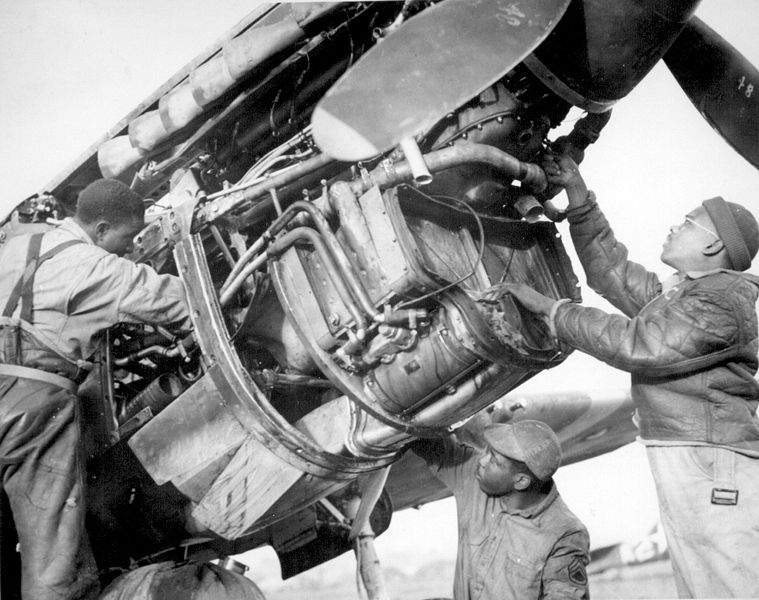
As is often the case, the men who supported the fliers can be overlooked. The Tuskegee airmen were supported by their own black ground crew, as a segregated African-American unit. (Mechanics of 99th FS "Tuskegee Airmen" (332nd Fighter Group-15th USAAF) repairing P-40 engine.) USAF Official.
Shunned initially, the Red Tail pilots and their crews overcame the dire circumstances of discrimination and their performance became legendary. They soon became the “requested” fighter escorts by the white bomber pilots. Flying over 15,000 sorties in more than 1,500 missions, they compiled an outstanding combat record. As bomber escorts, the Tuskegee Airmen lost very few bombers to enemy fighters, which earned them the nickname "Red Tail Angels". Sixty-six gave their lives in combat and 32 were captured as prisoners of war.
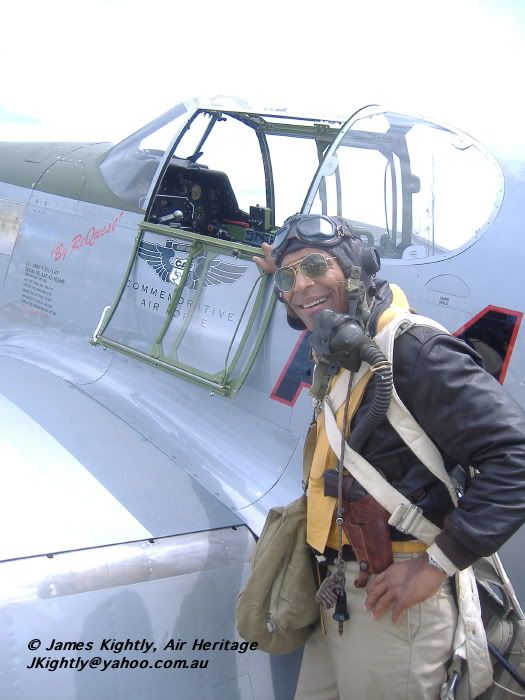
A recreator with the Minnesota Wing 'Red Tail' P-51C Mustang 'By Request' at Oshkosh 2009. Author.
Beyond the incredible achievement of these young black men is the way their story has become an exemplar for a focus on a disadvantaged minority in aviation. Today there is extensive coverage of the red tails in numerous places and media. Some are quite surprising, like the Commemorative Air Force's (CAF) 'Red Tail' P-51C Mustang. While this aircraft is actually operated by the Minnesota Wing of the CAF, it shows how far the CAF (who were, of course, famously the Confederate Air Force - a witty riff on their Texan origins but not a joke to some, resulting in an enforced name change in 2002.)
As the Minnesota Wing website states:
The decision was made to paint this rare aircraft in the distinctive colors of the Tuskegee Airmen~ the 332nd Fighter Group ~ and, in so doing, honor these long neglected heroes who, during World War II, accomplished a "double victory"; one over nazism and the other over racism. The importance and justification of this decision was ratified by the Minnesota Legislature with a substantial monetary grant towards its ultimate completion.
The Minnesota Wing have set up a website called 'www.Red Tail.org' on the story and the wide variety of related projects.
Kermit Weeks tells part of the Red Tail's story before flying his P-51C at Fantasy of Flight, January 2007. James Kightly. Meanwhile in an ex-Confederate state, Florida, Kermit Weeks' Fantasy of Flight near Orlando has a display relating to the Tuskegee Airmen, and is centred around his P-51C in the colours of Lieutenant Colonel Lee 'Buddy' Archer. Lt Col Archer became the only Tuskegee pilot to shoot down five enemy aircraft. (Regular events are also held, with a 'They Dared to Fly' symposium in February 2010 coming up.)
There are, it seems, numerous other commemorations of this once sidelined story of achievement (including a 1995 HBO TV Movie, and another George Lucas led film project under way entitled 'Red Tails') to the extent that it can seem to be over-promotion of what was of course only a small part of the huge war effort and air forces of the United States - but the merit of the case should outweigh and such criticism. A T-1A Jayhawk of the 99th Flying Training Squadron at Oshkosh painted in honour of the Tuskegee Airmen, including a red tail. Erik Schwerman.
Meanwhile this raised profile has unexpected effects. While only a few years ago few would have heard of these airmen, today many aviation history enthusiasts are au fait with the story, thanks to the work of those highlighting it. one fascinating story was posted on the WIX forum by Craig Thorson ('Craig59'):
I was standing at the departure gate in Detroit last Saturday - Oh'dark early - looking at the weather radar online when I noticed a slightly built, older gentleman preparing to board. He was wearing a leather flight jacket and a Tuskegee Airman ballcap. I couldn't hold myself back.
I walked over and introduced myself. Lt. Colonel Alexander Jefferson introduced himself as he shook my hand with a grip that belied his years. Though I knew he had to be in his mid-eighties (actually 88), he looked and spoke like a man twenty years his junior. I thanked him for his service and told him what an honor it was to have him on board. True to the form of men of his character, he brushed aside any notion of being special - but I knew otherwise - and I would learn much more when I returned home and Googled his name.
Tuskeegee Airmen Lt. Col. Alexander Jefferson (left) and Captain Edward Woodward. NASA.
As he boarded, the agent asked me what was so special about the gentleman. I gave the briefest of explanation about the Tuskegee Airmen and she kindly asked, "Would you like me to upgrade him to first class?" When I walked down the jetbridge and handed the Colonel his new boarding pass, he let out with, "Holy Toledo!" He was genuinely touched.
As I mentioned, I already knew he was a hero - fighting an enemy on two fronts - but I had no idea until I returned home. On his eighteenth mission, he was shot down and spent the last 9 months of the war as a POW of the Nazis.
Sometimes getting people from A to B has its special perks.
Craig added a link (shown below) to an excellent film segment of the Colonel's story, in Jefferson's own words, and it's worth noting that from his biography here, the sketches are his own from his prisoner of war experience. Many thanks to Craig to his quick reactions and action and relaying that neat meeting.
As is shown in the video, the achievements and story of the Red Tails has effects to today, with the Congressional Gold Medal being awarded to the Tuskegee Airmen in 2007 by President George W Bush, who noted “Even the Nazis asked why African American men would fight for a country that treated them so unfairly.” Shortly after, some very proud airmen in the audience for the inauguration of the first black president of America in December 2008.
I am a training cadet pilot with South African Airways (SAA). SAA, for the past 40-50 yrs has never had any black pilots. With our recently found democracy, it was decided that the airline has to start to represent the demography of the country and, of course, start to behave like an African airline. We (12) have been selected as front runners to be amongst the first black airline pilots in South Africa. We are busy training in Australia and we have found that flying is seen very much as a 'white profession' today. We have had considerable difficulty coping with the course due to racial matters. Our favourite movie of all time is the Tuskegee Airman. I am in shock that I am in contact with a descendant of one of the airman. Your dad, is an inspiration to all of us. He was a great man to fight the odds and win in those days. I just want to email you and just tell you that.
Arthur Phaswana
History has moved from 'kings, battles and dates' to a more diverse and inclusive multi-stranded set of stories. The history of the Tuskegee Airmen shows what new directions such breadth can achieve in the study and understanding of history. In the words of the Men in Black 'imagine what you'll know tomorrow...'.
Postscripts - One might wonder what other black airmen there were in W.W.II. Australia famously had one Aboriginal pilot (Warrant Officer Len Waters who flew a P-40 Kittyhawk named 'Black Magic') while among many other races serving the British were a number of men from Jamaica. Stories, perhaps, for a post another time.
Another comparable area this can be used as a benchmark for is the history of women in military aviation. I may look at these in a later post.
Response to Guy's comment: Thanks Guy, The intent is to go into the British and Commonwealth story in detail another time - not least because of the similarities and differences of the racism faced by other colours in the Commonwealth forces is a more complex story, given the nature of the Empire. It's probably fair to say that institutionalised racism wasn't generally prevalent (however one must at least except India, where it was) but the issues faced by the airmen were as disgraceful as those faced by the African Americans - and with issues running to today as shown by the Ghurkha supporters action in the English parliament. Appreciate the input! James
American P-47 Thunderbolt getting some maintenence in the dispersal area of a makeshift airfield in the French countryside following the Allied invasion of Normandy. August 1944, photographer: Frank Scherschel.
After being brought up by Shay on the WIX forum, some very interesting details spotted by the expertise and eye of several posters. It may be a cliche, but it's also true that different people see - and pull out - different things from the same image. (The full size photograph, part of the Life archive on Google, and useful for the points made, is to be found here.)
Taigh Ramey;
"I like the Cletrac M2 High Speed Tractor too! We are slowly restoring one here. In fact the engine just came back from the overhaul shop today.
The Cletrac has a high pressure (adjustable up to 2000 psi) engine driven air compressor on the back for tires, air tools and servicing the struts, which looks exactly like what he is doing. The line he is holding leads to the receiver cylinder and controls that are mounted on the left front fender.
The large bottle on the right front fender is a modification. I have seen other Cletracs with oxygen bottles mounted on the right side for servicing the O2 systems so I would wager that's probably an oxygen cylinder.
The Cletrac also had an engine driven generator on the right front fender which put out 115 volts DC for running lights and certain power tools. This tractor was quite the service vehicle for the AAF and went on into Korea.
Sorry if I hijacked a thread about the P-47. I think the Cletrac and the jug were probably designed by the same folks since they were both built like a tank!
I really like the nose art on the 500 pound GP's on the wing racks. I wonder if they did this for the Life photographer or was it just the normal routine?"
Meanwhile, Ryan Harris said; "Notice the over sized stars and bars under BOTH wings." and Brandon Kunicki responded to a question on the gun barrel alignment (a unique configuration on the P-47 anyway); "Looks like they are servicing the guns so they may have the barrels out or are in the process of removing/reinstalling the entire gun."
James Kightly ('JDK') is a professional writer and journalist covering vintage aviation. For James' professional and contact details see James' home page. For James' aviation writing blog, see Vintage Aeroplane Writer. To contact James by e-mail see Contact!
 It is interesting to explore the story behind some of the evasive, censored wartime publications. This 1940 Vickers-Armstrongs advertisement from Flight magazine is an interesting case in point. The original text in the middle reads:




 Posts
Posts


