Sunday, November 8, 2009

Timelapse Aeroshell Square

If you've been, if you were there, if you want to go, or are just interested, this is worth a look.

It is a neat time-lapse film of the AeroShell Square at AirVenture, Oshkosh 2009. It was filmed from the new control tower at Wittman Regional Airport, courtesy of EAA's Photo Dept.

It all takes place (thunderstorms and world's biggest aircraft and all) in 3 minutes 33 seconds and definitely includes me, somewhere, as I spent quite a bit of time back and forth through the this heart of the EAA's AirVenture.

It is fun to try and work out when I passed through (some points were easy because of remembering the aircraft arrangements as I was there) and, with the movements of several of the world's largest aircraft (dwarfing at least one W.W.II bomber at the time - see if you spot it) this film also highlights in a nutshell the organisation that the Oshkosh show requires.

This is not a piece of instant-web-gratification. It's worth getting it to load properly and having a tea, coffee, or G&T or champagne to hand as preferred.

James

Thanks to Zack on WIX for the lead.

Wednesday, October 28, 2009

Slow Rocket from Woomera

Space is not normally an area I propose to cover, but this item in today's Age newspaper is worth a note.

At the height of the Cold War when paranoia about Russia's space program was ramping up, a 12-year-old Denis Cox fired off an "urgent" letter to "a top scientist" at the Woomera Rocket Range containing his designs for a world-beating rocket. Now, 52 years later, Cox will finally get a response.

A fellow space aficionado and blogger, Bob Meade, tracked him down after the letter was dredged up by the National Archives of Australia and published on its website as the "Find of the Month" in May.

The publicity caught the eye of David Kilmartin, editor of the Defence Science and Technology Organisation's Connections magazine. Kilmartin has helped arrange a ceremony in Melbourne next month at which Cox will be presented with a framed response from a scientist in the DSTO's hypersonics section.
If only I'd sent off my skool sketches, maybe I'd be getting a response in ~uh~ about twenty more years.

More interesting is the way the connections were made, through blog, newspaper and archive.

James

Saturday, October 24, 2009

Comet Racer G-ACSS

This is my late eighties photo of the restored Comet Racer G-ACSS, 'Grosvenor House'.

It is on a flight from Boscombe Down, home of the last airworthy de Havilland DH-106 Comet jet airliner (appropriately named Canopus) to Hatfield, the home of de Havilland. This flight was the only occasion the Comet airliner and Comet racer flew together - and, given that Canopus is now grounded, it is unlikely that it could happen again. Incidentally G-ACSS, in the hands of the Shuttleworth Trust at Old Warden, is also currently grounded but should fly again in the future.

The Comet Racer was, of course, the winner of the 1934 MacRobertson Air Race from Mildenhall, Suffolk to Flemington Race Course, Melbourne, Australia. It was, arguably, the greatest air race (it's often known as The Great Air Race) and in historical terms there has never been another race that has occurred at such an important time of radical technical change.

Much has been and will be written about the Comet racer. Suffice it to say here was that in late 1934 it was the fastest thing to travel halfway around the world. It was a privilege to have seen such an historic aircraft on such a unique occasion as this.

Thursday, October 22, 2009

Mildenhall to Melbourne 75 years ago

What is often held to be the greatest air race in history started now, at the other side of the world, 75 years ago.

It was an incredible achievement. Thanks to the Flight archive and Time magazine's 1934 report, here are some photographs and extracts showcasing the key aircraft and some of the frantic activity before the start.

The team of Roscoe Turner, Clyde Edward Pangborn (right and left in the light colour coats) and Reeder Nichols in their 'Warner Brothers Comet' Boeing 247 arrive and dismount.


Take off date was set at dawn (6:30), October 20, 1934.


Month on long month of intensive preparations by the aviation industry throughout the world had preceded the race's start last week. Represented by each entry were countless technicalities, endless research, details, delays, many a heartbreak.
Time
'Battling' Ray Parer, who had flown the 1919 race from the UK to Australia, but was the last finisher then.

The aircraft had to be weighed. Here is one of the dedicated racing Comets built for national pride and at a bargain price by patriotic de Havilland.
The great doors of the Royal Air Force hangars opened wide at 3 a.m. One sleek machine after another was wheeled out. The deep-throated roar of their engines being tuned up fairly shook the field.
Time

One of the less well known contestants was the Airspeed AS.5 Courier G-ACJL of Squadron Leader D. Stodart, and Sergeant Pilot K. Stodart.

Of the 64 original entries, more than two-thirds had withdrawn. Night before the start Colonel James C. Fitzmaurice, Irish transatlantic flyer, had been disqualified when his U.S.-built Bellanca special, Irish Swoop, proved overweight.
Time

The Dutch entered the Pander Panderjager and a brand new Douglas DC-2, both seen here under guard at night before the race.

Two other less well remembered racers are 36, the Lockheed Vega Puck G-ABGK of J. Woods and D.C. Bennett, and 47, B.A. Eagle The Spirit of Wm. Shaw & Co Ltd G-ACVU of Flight Lieutenant G. Shaw.


Some men to watch. Above - C.W.A. Scott and Tom Campbell Black, and below, Captain K.D. Parmentier, First Officer J.J. Moll of KLM.


Chattering in little groups were flyers, mechanics, officials, men in dungarees, women in evening dress from London. At 6:30 a. m. Sir Alfred Bower, Acting Lord Mayor of London, gave the starting signal.
Time
First away were Jim and Amy (Johnson) Mollison, 12-to-1 favorites in their De Havilland Comet. Two minutes later Roscoe Turner and Clyde Pangborn took off in their big Boeing, just as an orange-red sun edged over the horizon. One by one the rest took the air and headed south. Last off, 16 minutes after the Mollisons, was Capt. T. Neville Stack, carrying a complete motion picture of the start.
Time
What happened next was not only a great and thrilling race, but a cornerstone of the development of inter-continental flight.

More soon.

Sunday, October 18, 2009

Hawking a Hawk - or not quite what it seems

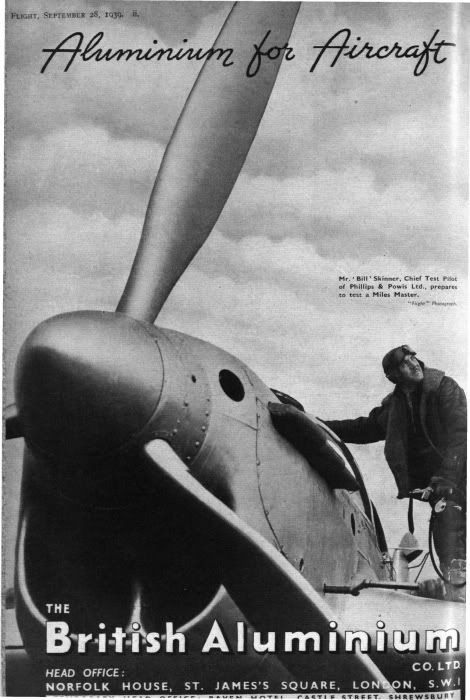
A fine pre-war advertisement. But not is all quite as it seems. The first oddity is that Miles were famous for their wooden aircraft. While we are looking at the metal engine cowls, propeller and fittings, it seems a bit odd that British Aluminium would choose a wood aeroplane to advertise their wares!

Then we note it's a Flight magazine advert for the Miles Master which, given the radiator position, is actually the Miles Kestrel, an early design that was developed into the Master, and with a number of detail differences, the critical one being the fact that the Kestrel's radiator block was under the engine in the nose, while the Master's was under the wing centre section. If you know that, you aren't going to mistake one for the other from this angle.

There was only one Kestrel built, in 1936 as the Miles M.9 Kestrel, c/n 330, and registered G-AEOC, flying in 1937 and scrapped in 1943. Here's the Kestrel from a different more revealing angle.

Source unknown.

And, for comparison, the Miles Master trainer.

Source unknown.

Both elegant designs, and efficient for the job. They were also the RAF's own preferred type that they couldn't get enough of, so the US designed and built North American Harvard (T-6) filled the shortfall. Had history been different, we'd be tripping over Miles Masters on every airfield, rather than those ubiquitous T-6s.

Here's a good Flight cutaway of the cockpit area. I like the instructor's visor and seat could be raised for a better view on landing. I'm not sure how practical that was on circuits and bumps.

Reproduced, with acknowledgement from Flight Global. A bigger version here.

Again, it's not what it seems. Flight have it listed under 'Miles Master' here yet the lack of a step in the canopy top and the small, upright and un-armoured windscreen don't match the Master but do match the Kestrel.

One last confusion. The Miles Kestrel was powered by - wait for it - the Rolls Royce Kestrel V-12 engine. Both companies named their products after birds of prey, Miles sticking mostly to hawks, Rolls Royce casting wider. One could presume that Miles chose to call this one the Kestrel as they'd not used the name before, and it fitted the engine it had. Intriguingly, I can't think of another aircraft where the engine and aircraft name is the same but the builders were different. I'm sure there must be - suggestions on the comments button please!

Tuesday, October 6, 2009

From Australia and Canada to Oshkosh

Sometimes it's worth travelling a long way to see something.

Sometimes that something's travelling quite a way to be there.


Canadian Warplane Heritage Lysander at EAA AirVenture, Oshkosh.

Friday, September 25, 2009

The multi-talented Cyril Peckham

Due to the inevitable focus on pilots in aviation, the huge range of other talented people involved rarely get a look in. In the middle of the twentieth century, there were numerous great photographers working, including the peerless Charles E Brown and others. One often overlooked is Cyril Peckham, who was multi-skilled as well as talented.

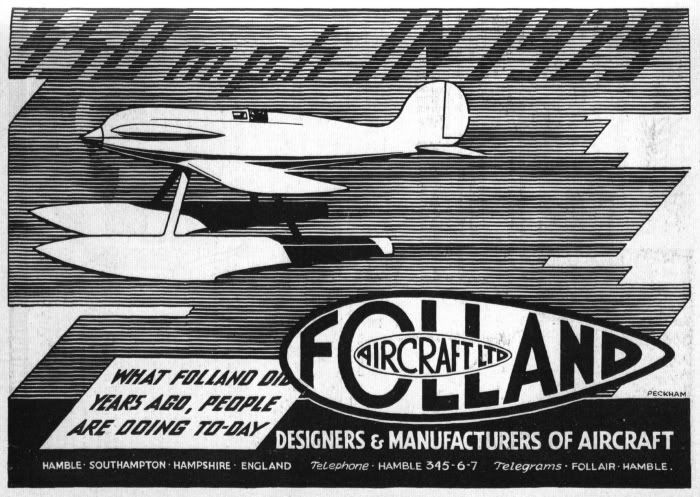
While looking at this rather nice illustration of a Folland racer, I noticed a very small signature at the lower right in the white area: 'Peckham'. Not a usual name, only encountered for the London suburb and the photographer I'd heard of. So a bit more looking produced a camera - the Peckham Wray as well:
Here's the story, from a Christie's auction page.
Peckham Wray camera no. 186
Peckham Wray, England; 5 x 4 inches, black-metal body, the top stamped ADMIRALTY PATTERN NO. 8901, focal-plane shutter and a Wray Lustrar 135mm. f/4.8 lens no. 42294; a Wray Plustrar f/6.3 9 inch lens no. 158117

Lot Notes: Cyril Peckham was a successful and well-known commercial artist and poster designer specialising in aviation subjects during the 1920s and 1930s. He had an active interest in photography and achieved the Fellowship of the Royal Photographic Society. During the second world war he moved from illustrator to photographer and joined the General Aircraft Company and later the Hawker company. He was active in aerial photography and drew up a list of ten faults with current cameras which led him to design his own.

'When the man who does the job designs the tool for doing it, the result should be something approaching the attainable ideal - from the functional aspect at least'. With this statement the BJPA reviewed the Peckham-Wray camera designed by Cyril Peckham who at the time was Chief Photographer to the Hawker Siddeley group of aircraft companies. The camera was originally designed for air-to-air photography and and was later developed as a press and general purpose camera.

British patent number 728741 was applied for in 1951 and the full specification was filed in November 1952. The specification for the camera addressed those faults that Peckham had identified including light traps, comfortable grip and fingertip controls. After some twelve months use Peckham showed the camera to the Chief of the Admiralty photographic section, Mr F. Wright, who initiated the first production run of fifty cameras from the Wray Optical Works in Bromley. The prototype camera at the RAF Museum in Hendon follows the patent specification closely but the transition from prototype to production negated some of the improvements Peckham had intended.

The prototype achieved most of Peckham's goals, bulk apart it was convenient to hold, the rear shutter release was in an ideal position and the focusing scale and aperture markings easy to use. A gloved operator would have no difficulty and it would seem to have been a first class air-to-air camera. If offered exclusively for this purpose fitted with a 5 x 4 Graphic-pattern back, as some of the production models were, it would have achieved greater success outside of Government circles, in fact the number sold to private users were negligible and it certainly stood no chance of being accepted in the Speed Graphic dominated Fleet Street as a press camera.

Jim Barron, 'Cyril Peckham and the Peckham/Wray Camera' in Photographica World, no. 60, March 1992, pp. 24-25.
Jim Barron, 'Reaching for the Skies' in British Journal of Photography, 19 March 1992, pp. 16-17.
British Journal Photographic Almanac 1956, pp. 232-233.

For those interested in the camera specifically, more here:
... A camera was made for Peckham to his own design, by a local engineering company, and was so successful that he soon found friends and colleagues pressing him to get the camera into some sort of commercial production. Wray got the job, under the promise of a Government contract. Wray’s version of Peckham’s camera did not exactly match the prototype. The 9 x 12cm German shutter mechanism used by Peckham was changed to a 5 x 4-inch English version. The casting was in a denser alloy than the original, the smooth lines of the first camera were not followed and the whole thing was heavier and more cumbersome. ...
How many of our current photographers are experienced graphic artists and have designed a specialised camera that was put into production? Flight, as ever, came up with a pic - here's the man with (presumably) the prototype camera from 19 December 1952.

Another excellent shot is on this interesting blog, presumably again using his own camera.

All very interesting, I think. There also seems to be another
Cyril G Peckham who published "A summary of atmospheric turbulence recorded by NATO aircraft." and was involved with "The Analysis of Sudden-Short-Circuit Oscillograms of Steam-Turbine Generators" - I hope it's not the same man, otherwise he'd clearly be the Leonardo of aeronautics.

Tim Badham adds:
I greatly admire the aviation photographers from that era. Indeed I was fortunate enough in the 1970s to be one of the winners in a competition concerning airshow photography. The photographs were judged by Arthur Gibson (well known for early Red Arrows pics) and that doyen of air-to-air work Charles E. Brown himself. I had the great honour to meet Charles at the award ceremony when winning photographs were exhibited at the RAF Museum. It was a wonderful day. Charles was of diminutive stature and quite frail by then but I was quite over-awed to be introduced to him. Thousands of his early photos were lost in a fire at his premises in the early days of his career. His earliest aviation pics were of balloons.

I never met Cyril Peckham but he too did some great work in the days when film was expensive, autodrive was not an option and you had to get it right first time!
Not to be forgotten, and we'll return to the great Charles E Brown another time, I'm sure.